Pipsan
The Summer BookPipsan is a quiet, unusually timid child who visits the island as Sophia’s first guest-friend and becomes the focus of Sophia and Grandmother’s protective imagination. Known formally as Herdice Evelyn, she is renamed Berenice within their proposed secret society: a queen celebrated for her hair and a constellation. Yet the child they surround with this imagery remains difficult to reach, and her vivid drawing reveals an expressive capacity that their efforts to manage her do not fully anticipate.
Identity and Arrival
One summer, Sophia has a guest of her own: Pipsan, a fairly new friend and the first friend to come and visit. Sophia admires Pipsan’s naturally curly hair, and Grandmother agrees that it is lovely. Her appearance is memorable, but her manner and clothing set her apart from the island’s more casual life. She arrives dressed wrong, wearing shoes with leather soles, and is described as too well bred and terribly quiet.
Sophia tells Grandmother that Pipsan is afraid of being asked her real name and, more broadly, afraid of everything. This is Sophia’s account of her friend, and it governs how the two older island-dwellers approach the visit: they decide not to frighten Pipsan, at least at first, with things she has never seen before. Care begins as careful accommodation, although it soon becomes an effort to supervise nearly every part of the child’s time.
The Secret Identity and the Work of Protection
Sophia says she has decided to be Pipsan’s protector and proposes that she and Grandmother form a secret society for that purpose. The plan makes Pipsan the center of a shared imaginative world, but Sophia also worries that her friend’s actual name does not sound aristocratic. Grandmother supplies the society’s private name for her: Berenice, after a queen renowned for her hair and a constellation. Pipsan is thus given a grand, symbolic identity by people who are trying to make her feel sheltered, even as the name belongs to their private game rather than to her own chosen self-description.
The protective arrangement changes Sophia’s routine. Pipsan wanders about the island as an unusually small and timid child who, in Sophia’s view, cannot be left alone. Sophia hurries from place to place and does not dare leave her guest by herself for more than a few minutes. Protection therefore has a practical cost: Sophia’s attention is continually tied to Pipsan, while Pipsan’s timidity limits what the two can do together.
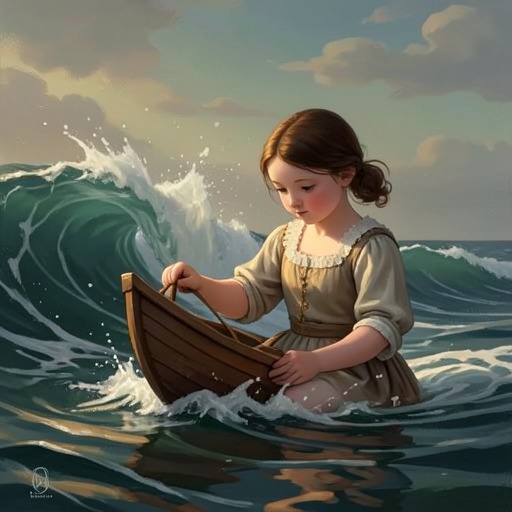
Grandmother hears Sophia puff up the stairs into the guest room and sit on the bed to complain in a whisper that Pipsan is driving her crazy. Pipsan will not learn to row because she is afraid to go out in the boat and says the water is too cold. The difficulty is not simply that she needs guarding; activities that might help her join island life are themselves frightening to her. Grandmother’s question about what to do with Berenice uses the secret name, showing how thoroughly their protective fiction has taken hold even as Sophia’s patience is strained.
The Potato Patch
When Grandmother asks where Pipsan is, Sophia says she is in the potato patch. Grandmother crosses the island with her walking stick to find her. The patch lies a short distance from the water, sheltered among rocks and in a place that receives sun all day. The family grows an early variety of seed potatoes there on sand covered with seaweed, waters them with salt water, and harvests small, clean, oval potatoes with a pinkish lustre.
Pipsan is sitting behind a large rock, half hidden beneath pine branches. Grandmother sits nearby and digs with her trowel. Although the potatoes are still too small, she digs up about a dozen and explains the planting process through the visible example: a large potato produces many smaller ones, and if they are left to grow, they become large. Pipsan looks at Grandmother briefly from beneath her tangled hair, then looks away. The lesson does not draw her in; she does not care about the potatoes, people, or anything at all. The scene places Grandmother’s patient, practical approach beside the child’s apparent refusal of interest, without suggesting that the explanation changes her mood.
Drawing and an Unfinished Response
Pipsan’s drawing becomes a sharper test of how Sophia and Grandmother understand her. Sophia whispers that Pipsan cannot draw and asks whether Grandmother gave her Sophia’s pad, questioning what Pipsan has to draw for. After the window slams shut and Grandmother lies down again, Sophia returns three times with dreadful pictures, pasting each on the window facing into the guest room. One shows a child with ugly hair screaming as large ants crawl over her; another shows the same child being struck on the head with a stone; the third depicts a shipwreck. Grandmother concludes from the succession that Sophia has worked off her anger.
Then a sheet of paper slides under the door. Pipsan’s drawing is good, made with painstaking fury. It depicts a creature with a black hole for a face, hunched shoulders, and long scalloped wings like a bat’s. The wings begin near its neck and drag along the ground, serving as a prop or perhaps hindrance to a vague, boneless body. Grandmother admires the picture as both awful and expressive. She calls out that it is good, but does not look at Pipsan; her voice is neither friendly nor encouraging. The praise recognizes the drawing without establishing a warm connection between them.
Pipsan remains on the steps and does not turn around. She throws a little stone straight up, then stands and walks slowly and dramatically down toward the water, while Sophia waits on the woodpile. Grandmother asks what she is doing. The episode ends with that question, leaving Pipsan’s action unexplained. Her drawing has made her expressive power unmistakable, but the story does not resolve whether the adults’ protection, Sophia’s frustration, or Grandmother’s praise has reached her. Pipsan remains both the child they try to interpret and a presence that resists being easily understood.